



Loading

Most accounts receivable software will tell you exactly what needs attention: which invoices are overdue, which payments landed unmatched, which accounts are drifting toward risk. What it usually won't do is act on any of that.
An AI agent for accounts receivable is built to close that gap. It reasons over your AR data and takes the next step itself, whether that's matching a payment, chasing a missing remittance, or sending a collections email, and stops to ask a person only when the situation calls for judgment.
That distinction matters more than it sounds, because "AI" and "automation" get used interchangeably in AR software marketing, and finance teams are left guessing what a platform actually does versus what it merely displays. A dashboard that flags 40 aging accounts still requires someone to open each one, decide what to do, and do it. An agent that flags the same 40 accounts and works 35 of them to resolution on its own leaves a person with 5 that actually need attention. That's the operational difference this piece is about: It will cover what an AR AI agent is, the work it can be trusted to own, how it differs from the rules-based automation most teams already run, and what to look for before you bring one into your process.
An AR AI agent is software that reasons over your receivables data, plans a sequence of steps, and executes them, rather than following a fixed script or simply flagging something for a person to review. Where a traditional automation rule might say "if an invoice is 10 days overdue, send a reminder email," an agent evaluates the account's payment history, the size of the balance, and any prior outreach, then decides what to do next and does it. If that same account paid on time for the last eight invoices and this one is late because of a documented shipping delay, the agent can recognize that context and hold off on an escalation a blunt rule would trigger automatically.
That capability only holds up with guardrails. A credible AR agent operates inside policy: it acts within limits your team sets, such as which accounts it can contact and what triggers escalation, logs every action it takes for audit purposes, and routes anything outside its defined authority to a person. An agent without those guardrails isn't something a finance team can put in front of customers or auditors, no matter how capable it is. Introducing accounts receivable with Nuvo covers how that governance gets built into a live AR process rather than bolted on after.
The clearest way to evaluate an AR agent is by the tasks it completes end to end, not the dashboards it generates.
Cash application is repetitive by nature: open a bank notification, find the matching invoice or invoices, and post it. An agent reads remittance advice, bank files, and payment emails, matches the payment to the right open invoices, and posts the entry to the ledger, without a person opening each file by hand. The harder cases are where this matters most: a single payment covering a dozen invoices, a customer paying multiple accounts in one wire, or a partial payment that needs to be split correctly across open balances. An agent handles those the same way it handles a simple one-to-one match, which is what actually removes the work rather than just speeding up the easy cases.
A payment with no remittance detail is where cash application usually stalls. Rather than parking the payment in an unapplied cash account, an agent identifies the gap, drafts a request to the customer for the missing detail, and applies the payment once the information comes back, closing a loop that used to sit in someone's inbox for days. Left unresolved, unapplied cash distorts the aging report and hides which accounts are actually current, so an agent working this queue continuously keeps the ledger accurate in a way a person checking it once a week can't.
A short pay requires figuring out why before anyone can resolve it: a pricing discrepancy, a damaged shipment, an unauthorized chargeback. An agent pulls the relevant order and pricing history, diagnoses the likely cause, and works the resolution with the customer, escalating only when the cause isn't clear from the data available. That's a meaningfully different bar than most deduction tools clear, since flagging that a deduction exists is the easy part; diagnosing why it happened and closing it out with the customer is where the actual hours go on a manual process.
Instead of running every past-due account through the same reminder cadence, an agent prioritizes accounts by payment behavior and risk, drafts outreach suited to each one, and sends it, adjusting timing and tone as an account's behavior changes rather than waiting for a person to update a rule. A customer who's a week late for the first time in two years gets a different message, at a different point, than one whose payments have been slipping for three months running. A well-run dunning process depends on that kind of account-by-account judgment, which is exactly what a static reminder schedule can't provide.
Rules-based automation and AI agents both reduce manual work, but they solve different problems. A rules engine follows a script: it does exactly what it's configured to do, and nothing more, which makes it reliable for predictable, well-defined tasks and brittle the moment a case falls outside the rule. An agent reasons across the account's actual data, including payment history, correspondence, and order context, and decides what the situation calls for, which is what lets it handle exceptions a rules engine would otherwise kick back to a person.
That difference is also why the two aren't mutually exclusive. Most AR processes still benefit from clear rules for the parts of the cycle that genuinely are predictable, with agents layered on top to handle the judgment calls, the missing information, and the accounts that don't fit the standard pattern. Gartner reports that 57% of finance organizations are already implementing agentic AI or planning to, and 54% of CFOs name AI agents a top finance transformation priority for 2026, which suggests most finance teams are actively working out where that line sits. Nuvo's broader view on where this is headed is in Nuvo is expanding agentic AI across the physical economy.
Nuvo Intelligence is built around that line. Its agents work across onboarding, credit, and accounts receivable on shared customer context, so a payment behavior signal from AR can inform a credit decision through automated credit decisions, and a shift in a customer's risk profile can reshape how collections outreach gets prioritized, without a person manually connecting the two. That shared context is also what sets an agentic order-to-cash network apart from point solutions that only automate one stage.
Vendor claims about "AI-powered" AR software are easy to make and hard to verify from a demo. A short set of questions cuts through most of it:
These are the same questions worth asking of any credit management automation platform, since the line between acting on data and merely surfacing it runs through credit decisioning as much as it does AR.
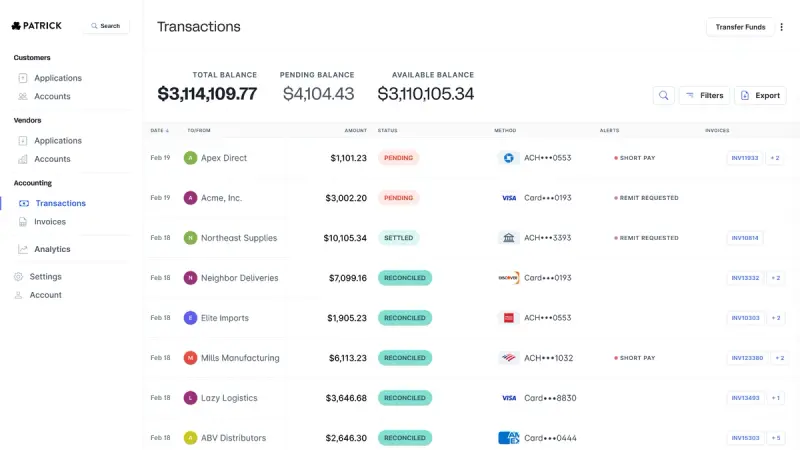
Use AI agents in your accounts receivable workflows with Nuvo.
The value of an AR AI agent isn't that it's smarter than your team. It's that it can be trusted to run the routine, high-volume parts of receivables, including matching, chasing, resolving, and following up, continuously and correctly, so your team's time goes to the accounts and decisions that actually need a person.
Give your team a set of agents that match payments, chase remittances, and work deductions to resolution around the clock, with every action logged and under your policy. See how Nuvo Intelligence works alongside accounts receivable to put that to work in your process.
An AI agent for accounts receivable is software that reasons over your receivables data and takes action on it, rather than just displaying it for a person to work from. It can match payments to invoices, chase missing remittance detail, diagnose and resolve short pays, and send collections outreach, operating within policy limits your team sets and escalating anything outside that authority to a person.
Traditional AR automation follows fixed rules: a defined trigger produces a defined action, and anything outside that scope gets kicked to a person. An AI agent reasons across account data, including payment history and correspondence, to decide what a situation calls for, which lets it handle exceptions and edge cases that a rules engine would flag rather than resolve. Most AR processes use both, with rules covering predictable work and agents handling the judgment calls.
Yes, within clearly defined limits. A well-built collections agent operates under policy your team sets, logs every action it takes, and escalates accounts that need a person's judgment, such as disputes or accounts approaching legal action. The trust comes from the guardrails and audit trail, not from removing oversight, so your team retains control over what the agent is allowed to do and can review its work at any time.