



Loading

Net 30 terms shape every credit manager's working capital. Approve them for the wrong customer, and you're managing late payments, absorbing bad debt, and watching your DSO climb. Deny them too often and you lose deals to competitors who'll take the risk you won't.
The gap between those outcomes is your credit decision—and it hinges on knowing which customers can actually handle the terms you're extending.
Net 30 has become the standard payment window in business-to-business (B2B) commerce, especially across manufacturing, distribution, wholesale, and construction. The 30-day window is typically long enough for buyers to turn inventory into revenue or clear internal approval processes, but short enough to keep suppliers' cash conversion cycles manageable.
Every time you approve net 30 terms, you're making a calculated bet on a customer's ability and willingness to pay within that window. That bet shapes your DSO, your working capital, and your ability to grow without hitting liquidity constraints.
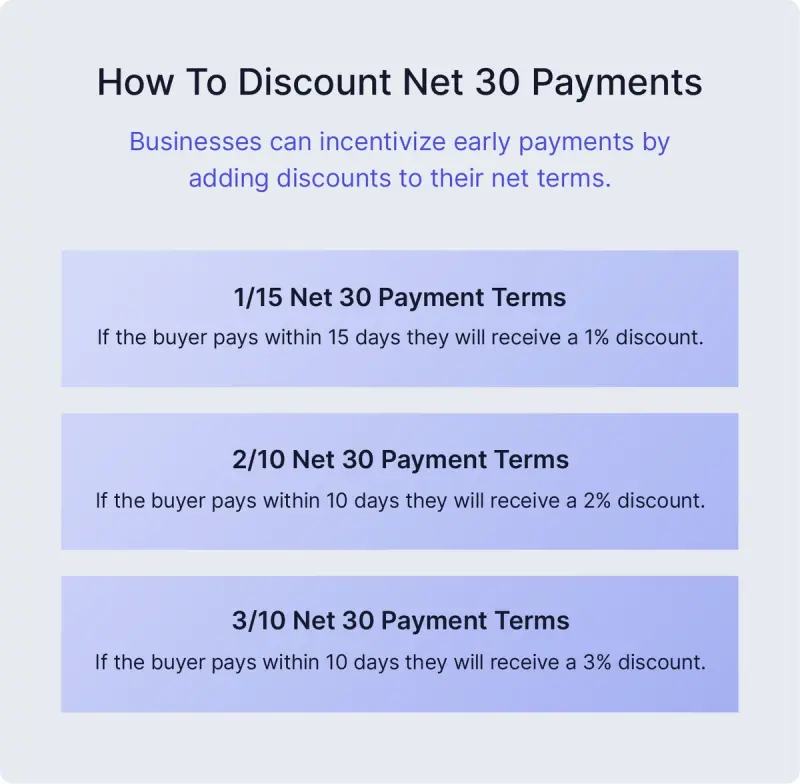
Net 30 isn't the only option, and in some situations, it's not the right one. Your cash flow timing, customer profile, and industry norms might call for shorter payment terms or longer payment terms.
Beyond the payment window, early prompt payment discounts add another layer of flexibility. A 2/10 net 30 term means the buyer gets a 2% discount for paying within 10 days of the invoice date; otherwise, the full payment is due in 30 calendar days.
On a $50,000 invoice amount, that's $1,000 you're giving up to get paid three weeks earlier. Whether that trade-off makes sense depends on your interest rate or cost of capital.
If you offer 2/10 net 30 and the buyer takes the discount, you're basically paying an annualized rate of roughly 36% to access cash 20 days sooner. Expensive, but sometimes the right call if you're managing a cash crunch or your credit line costs more than the discount saves.
The key variable across all of these is what each term does to your DSO and working capital. A shift from net 30 to net 60 delays every payment from that customer going forward, not just the first one. That compounds quickly as your book of business grows.
Net 30 terms offer real advantages when extended to the right customers under the right conditions. The upside shows up in deal flow, customer relationships, and market reach.
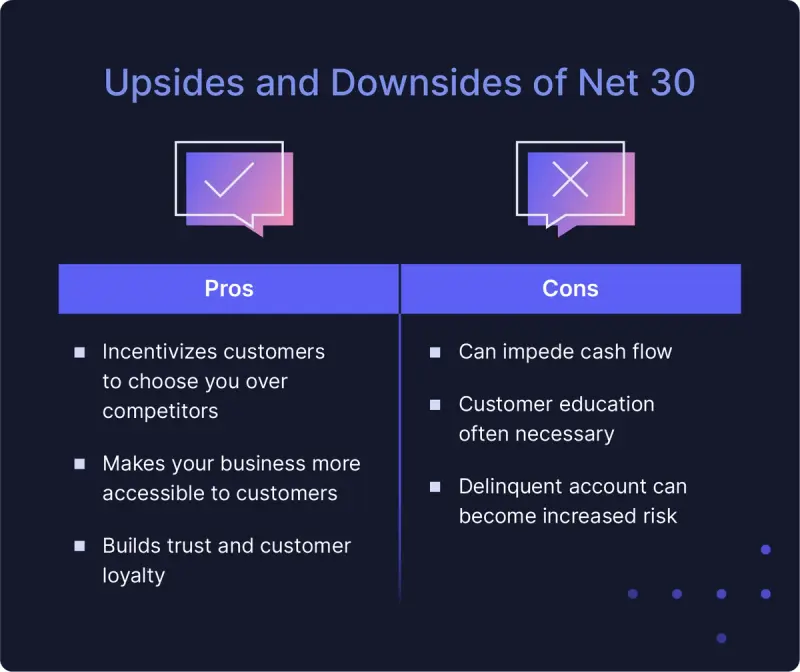
In markets where products are commoditized, like wholesale distribution, industrial supplies, and building materials, payment terms often matter more than price. If your competitor requires immediate payment and you offer net 30, you've removed a meaningful barrier to doing business.
This is especially true when selling to smaller buyers or business owners with seasonal cash flow. A distributor selling HVAC equipment closes more deals in Q1 by offering net 30 terms to contractors who won't see revenue until installation season. The product is identical, but the terms make the difference.
Net 30 gives buyers breathing room to convert your product into revenue before the invoice comes due. A fabrication shop buying steel might need two weeks to process raw material into finished goods and another week to invoice its own customer. Requiring payment on delivery eliminates them as a prospect entirely.
Extending terms expands your addressable market to include buyers who need trade credit to operate:
The key is knowing which customers can handle the terms and having a consistent process to make that call quickly.
Offering net 30 terms signals trust. You're betting that the customer will pay, and when that bet pays off, it builds a relationship that's harder for competitors to disrupt. Buyers remember which suppliers worked with them when cash was tight or when they were scaling quickly.
That goodwill compounds over time:
A customer who pays reliably under net 30 terms becomes a lower-risk account, one you can reward with better terms or higher credit limits, deepening the relationship further.
The benefits of net 30 are real, but so are the costs. Extending credit without a clear-eyed view of the downside is how credit teams end up with bloated DSO, strained working capital, and write-offs that were avoidable.
Every invoice you send on net 30 terms is cash that won't arrive for at least a month, assuming the customer pays on time. Many don't. Industry data consistently shows that as much as 55% of B2B invoices in the U.S. are paid late.
The impact compounds quickly:
If you're extending net 30 terms across a large customer base without systematic tracking, the administrative burden alone can drag on your team's capacity. Pairing flexible terms with disciplined trade credit automation is one way to keep that overhead manageable.
When a customer can't or won't pay, net 30 terms convert a sale into a loss. Bad debt write-offs hit your bottom line directly, and the risk isn't evenly distributed.
Newer customers, businesses with thin margins, or buyers in cyclical industries carry higher default risk, especially during economic downturns when cash flow problems cascade through supply chains.
The mitigation is to evaluate small business creditworthiness rigorously before approving terms:
All of these reduce the guesswork. Without them, the credit decision rests on what the applicant told you. And everything they didn't.
The decision to extend net 30 terms shouldn't be driven by sales pressure or competitive habit. Ground it in criteria your credit team can apply consistently.
The right terms evolve as relationships mature and payment behavior accumulates. Look at your last ten net 30 approvals. Which signals drove each decision: verified information, payment history, cash flow data, industry context? Where did your team fill in gaps with judgment instead of data?
Build a process that removes guesswork from credit decisions. Learn how Nuvo automates creditworthiness checks, verification, and risk scoring to help you approve faster and safer.