



Loading

Most order-to-cash (O2C) software automates one stage and stops there. A cash application tool matches payments but knows nothing about the credit decision that sets the terms. A collections module works an aging report that's already stale, with no line back to the onboarding data that explains who the customer is. Each tool does its job, and the finance team still spends its days moving information between them.
That fragmentation has a cost you can measure. In The Kaplan Group's 2025 DSO survey, only 14% of companies collect in under 30 days while 70% of larger companies carry a DSO above 46 days, and the Association for Financial Professionals treats DSO as a core treasury metric for that reason. When the order-to-cash cycle runs across five disconnected systems, every handoff adds days, and every day a customer doesn't pay is working capital you can't use.
Order-to-cash automation software is meant to close those gaps, and the platforms below differ in how much of the cycle they actually automate and how much still waits on a person. This comparison looks at what each one runs, from onboarding through cash in the bank.
The order-to-cash cycle spans order capture, credit decisioning, invoicing, payment processing, cash application, dispute resolution, and collections. Your fit depends on which stages slow you down today and whether you want connected automation or a focused tool for one job.
Nuvo is an AI-native order-to-cash platform that connects customer onboarding, credit, and accounts receivable in a single workflow on shared data. It's built for B2B physical goods companies, including building materials, food service, chemicals, and distribution, that want the full cycle to run without manual handoffs between sales, credit, and finance.
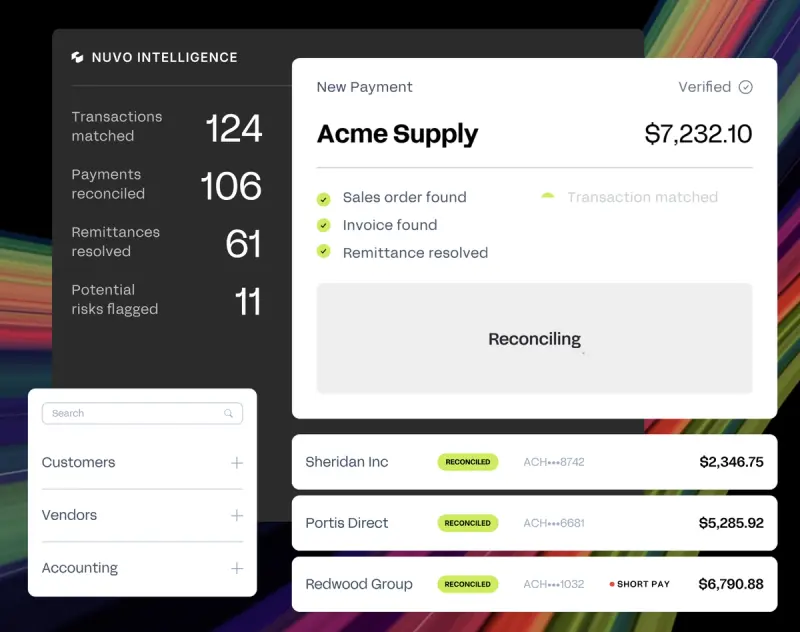
Limitations: Nuvo is purpose-built for B2B trade credit in physical goods, not consumer lending or services billing, and initial setup maps your credit policy rules and connects your systems before agents take over.
Best for: B2B distributors and manufacturers that want one platform running the whole cycle on shared customer context instead of separate tools for each stage.
HighRadius offers an order-to-cash suite covering credit, invoicing, cash application, deductions, and collections, aimed at high-volume operations that want autonomous receivables integrated across the cycle.
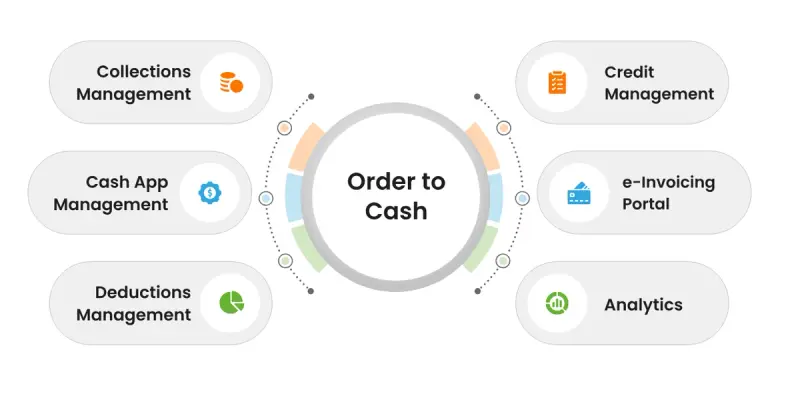
Limitations: Pricing and implementation skew toward large enterprises, with rollout timelines that frequently run several months. The breadth can feel heavy for teams that only need a couple of stages automated.
Best for: Large enterprises with complex receivables operations that want the full O2C cycle automated under one vendor and have the resources for a longer implementation.
Esker provides cloud-based O2C automation sold as modules across order management, invoicing, cash application, collections, and credit, so teams can adopt one part of the cycle and add others over time.
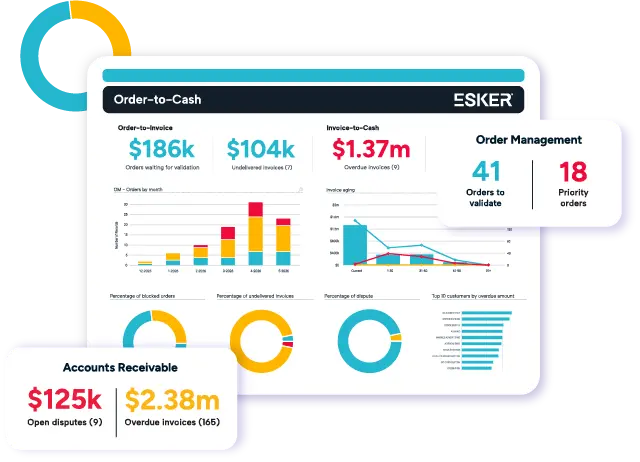
Limitations: Esker is sold à la carte, so full-cycle coverage means licensing several modules, and the platform is built for enterprise-scale operations that can feel heavy for mid-market teams.
Best for: Companies that want to automate the O2C cycle in stages and may already use Esker for one function before expanding to others.
Billtrust focuses on the accounts receivable side of order-to-cash, connecting invoice delivery, payments, and cash application, with credit application intake feeding the AR workflow.
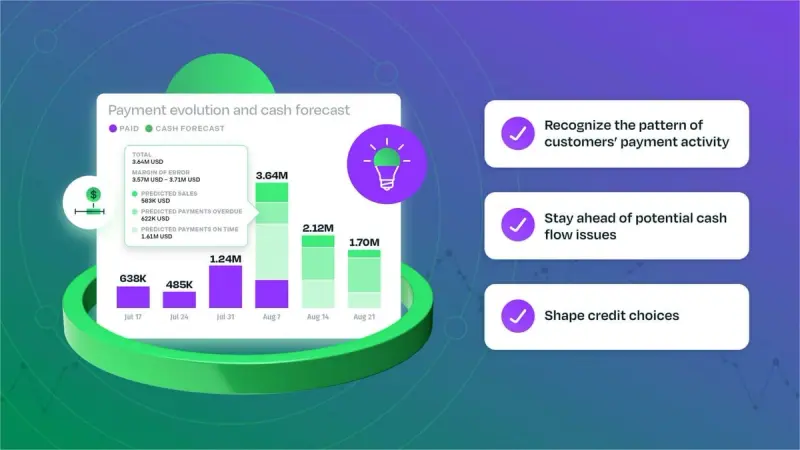
Limitations: Billtrust is strongest on invoicing, payments, and cash application, with credit a lighter part of the suite, and capabilities work best inside the full Billtrust platform.
Best for: Mid-market and enterprise companies whose main bottleneck is invoicing, payments, and cash application rather than credit onboarding.
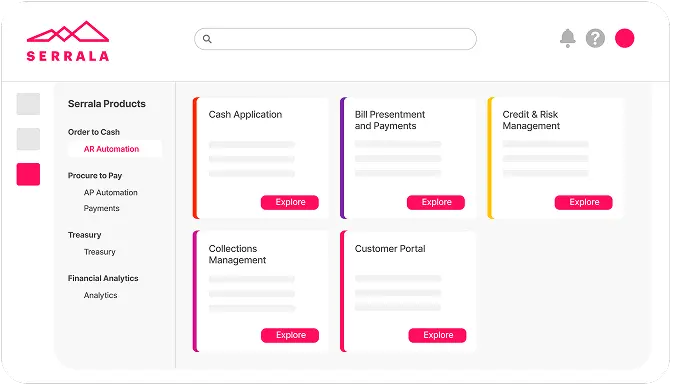
Serrala automates finance operations across order-to-cash and adjacent treasury functions, with cash application, collections, credit, and payments management for enterprises running SAP-centric environments.
Limitations: The depth in SAP environments is a strength but can be a heavier fit for teams on other ERPs, and the treasury breadth exceeds what a receivables-focused team needs.
Best for: Large SAP-centric enterprises that want receivables automation alongside broader payments and treasury operations.
Feature lists look similar across vendors. Judge each of the four areas below by the work it takes off your team and the metric it moves.
Manual onboarding is where the cycle loses its first days. References get emailed, bureau reports get pulled by hand, and a credit decision that should take hours stretches into weeks. Suppliers on Nuvo cut customer onboarding time by 80% to 90%, taking a new buyer from credit application to first order in hours.
Strong automation in this area include:
The capability that matters most is whether onboarding captures everything needed to start ordering and paying, including payment authorization, rather than approving a credit line with credit management software and handing the rest off to another system.
Invoicing usually runs out of the ERP while payments arrive across separate channels: ACH and wires to a bank account, checks to a lockbox, and cards through a processor. Reconciling across those feeds is manual work that scales with revenue.
Look for a platform that consolidates payment methods and gives buyers one place to see and pay open invoices. When payment authorization is captured at onboarding, the payment method is on file when the invoice comes due, which lifts on-time payment rates and stops AR teams from tracking down payment details mid-billing.
Cash application is the stage most often done by hand, with an analyst opening remittance emails and tying each payment back to an invoice. It's also where automation pays off fastest, with AR platforms commonly delivering large reductions in manual cash application time.
When examining verification capabilities, check whether the platform matches payments automatically across every method and resolves short pays and deductions to closure, instead of just flagging them. Real-time matching that reconciles before settlement keeps your cash position current instead of a day behind.
Most collections work starts from an aging report that's outdated the moment it exports, and reminders go out on a calendar, disconnected from what's actually happening on the account.
Effective collections automation covers:
Tie this back to DSO: Collections that act on current data and resolve disputes faster pull days out of the cycle.
To effectively evaluate O2C automation, work through four questions, in order:
A tool that automates cash application but can't see the credit terms, or one that runs collections without the onboarding context, leaves you reconciling across systems even after you've automated each piece.
Many platforms flag an exception, prioritize an account, or recommend a decision, then wait for a person to complete the task, which still leaves the work on your team's plate. Nuvo Intelligence, for example, writes decisions, posts cash, resolves discrepancies with the buyer, and sends collections outreach automatically, with every action logged and your team able to override or pause an agent at any step.
For any software you consider, request a demo, and ask what the platform does on its own versus what it hands back to you.
Put numbers on three questions:
Those answers tell you which stages to prioritize and which features matter, versus which just look good in a demo.
Walk vendors through the hard cases:
How the platform handles these reveals whether automation will hold up against your reality or add another system to manage around.
Fragmented automation moves the bottleneck: Automate cash application alone and the delay shifts to collections, or automate credit alone and the gap reappears the moment a customer is handed to AR. The platforms that change your numbers are the ones where onboarding, credit, AR, and collections run on one set of customer records, so context built upstream is available downstream and no stage waits on data trapped in another tool.
Before you book a demo, map your last 10 orders from placement to cash and mark every point where work stopped while someone moved data between systems or waited on a manual review. If those stalls cluster at the handoffs between onboarding, credit, AR, and collections, a connected platform will do more for your DSO than automating any single stage.
Run the full order-to-cash cycle on one platform instead of one stage at a time, with agents that carry context from onboarding through cash application and act on it.
Nuvo connects the cycle, filling common gaps to keep tasks and approvals moving. To see how our automation can support your team and improve your overall system, contact us and request a demo.