



Loading

A supplier's credit team is chasing an incomplete form and references that never answer the phone. On the other side, a buyer's procurement team is waiting on payment terms so they can place an order that's already been agreed on. Both sides are stuck on the same document: the trade credit application. Done well, it accelerates a new trading relationship. Done on paper or a static PDF, it stalls one for weeks, and the friction compounds on both sides of the desk: the credit analyst re-requesting the same missing field for the third time, and the buyer's finance team wondering why a routine account setup is taking longer than the deal itself did to negotiate.
This guide covers what a trade credit application actually verifies, what belongs on it, why static versions slow everything down, and how to turn a completed application into a fast, defensible credit decision.
A trade credit application is the form and process a buyer completes to be approved for payment terms with a supplier, such as net 30 or net 60, instead of paying in advance or on delivery. It exists to verify that the business is who it says it is, that it can pay what it owes, and that its payment history with other suppliers supports extending credit.
A complete, verified application is the foundation of a fast, defensible credit decision. When a file is missing bank details, when references don't respond, or when the business's identity hasn't been confirmed against an independent source, a credit analyst is left to either guess or chase, and neither option is fast. The application is where a credit decision either gets the information it needs or doesn't, and everything downstream, including how quickly the buyer can place their first order and how confident the supplier is in the limit they've extended, depends on which one happens.
Each field on a well-designed application exists to verify something specific. The fields fall into four groups.
This covers the legal business name, entity type, tax ID, and years in operation, verified against a source like a secretary of state registry rather than taken at face value. Confirming that a business exists and is who it claims to be is the foundation everything else builds on, particularly as fraud grows more sophisticated. Only about a third of financial organizations catch most fraud at the onboarding stage, according to, which makes verifying identity at intake, rather than trusting the submitted documents, the difference between catching a problem early and finding it later.
Bank account details, annual revenue, and, for larger credit lines, financial statements give a credit team a read on the applicant's capacity to pay. Bank verification confirms the account is real and active, which matters because a bank statement alone can be altered convincingly enough to pass a visual review, and a credit team relying on the document as submitted, rather than a direct connection to the account, is trusting a file that's easy to fabricate and hard to catch by eye.
References from other suppliers show how the business actually pays when credit is extended, which is a closer proxy for future behavior than financials alone. A bank reference adds a view of the account's standing that trade references don't cover. Traditional bank references, though, come with real limitations worth understanding before you rely on them, covered in cash flow underwriting as the answer to traditional bank references. References are also, in practice, the slowest part of most applications, since collecting them depends on a third party responding, and a credit team has limited leverage to speed that up once a request has gone out.
A signed authorization allows the supplier to run a credit check, and for higher-risk accounts, a personal guarantee attaches an individual's liability to the business's obligation. Capturing this at application, rather than negotiating it after approval, keeps the credit decision and its legal backing in the same file.
Industry-specific requirements, such as licensing or certification, and optional fields like a D-U-N-S number, aren't universal necessities, but they strengthen the file for applicants where they're relevant.
A static form, whether it's on paper or a fillable PDF, has no way to enforce completeness. A required field is only required if there's a system checking for it before submission, and a PDF doesn't check anything. The result is applications that arrive missing a tax ID, a bank account number, or a reference contact, and a credit analyst who has to go back to the applicant before review can even start, often more than once on the same file.
Static forms also can't verify anything on their own. A business name, a tax ID, a bank account, all of it has to be manually checked against outside sources, which means someone on the credit team is doing lookups that a connected system could do automatically at intake. That gap is more than an efficiency problem: an estimated 95% of synthetic identities pass onboarding checks that rely on document review rather than independent verification, according to Equifax's research on synthetic identity fraud, which means a paper application isn't just slow, it's also the weaker control. And because a paper or PDF application typically isn't connected to the ERP, an approved application gets rekeyed by hand into the system of record, introducing the kind of transcription errors that surface later as a mismatched customer record.
A digital application changes each of these. Required fields block an incomplete submission before it reaches a credit analyst. Verification against bureau, banking, and business registry data can run automatically the moment the form is submitted. And a connected application flows directly into the systems that use it, without a second round of data entry.
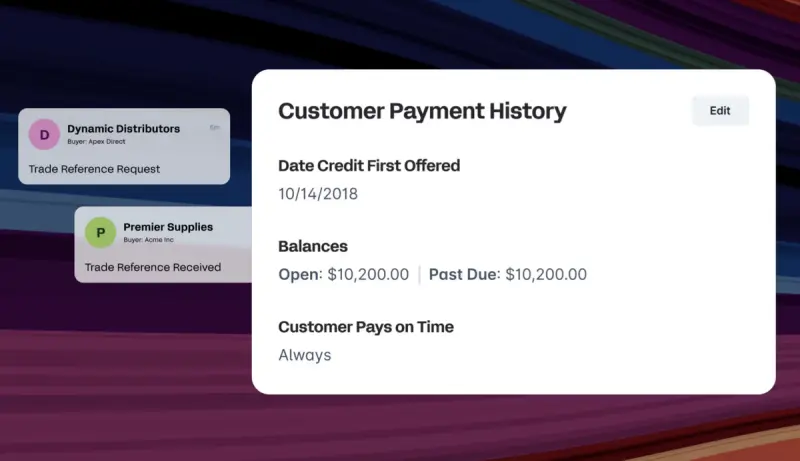
Software like Nuvo can help automate your trade credit application process.
A complete application is the starting point for a decision, not the decision itself. Getting from application to approval quickly means connecting the intake process to verification and decisioning, rather than treating them as separate steps a person has to shepherd between systems.
Required fields, format checks, and conditional logic (asking for a personal guarantee only when the requested credit limit crosses a threshold, for example) catch incomplete or malformed submissions before they reach a person, which is the single biggest lever for reducing back-and-forth.
Once a complete application is in hand, verification against a business registry, a bank connection, and bureau data can run without anyone requesting it manually. Trade references can be sent and tracked automatically, which matters because automated trade references close on faster response rates than a credit analyst emailing each contact individually and waiting.
With a verified, complete file, low-risk applications can clear against your credit policy automatically, and only the applications that fall outside defined thresholds need to reach a person. That's the difference between a credit team reviewing every application from scratch and a credit team reviewing the exceptions that actually need judgment.
Nuvo's configurable digital applications build KYB verification, bank connections, and trade reference collection into intake itself, so a complete application arrives verified rather than waiting on a separate round of manual checks. See how customer onboarding and decisioning automation work together to move a submitted application to a decision.
A credit team handling a handful of applications a month can absorb some manual chasing without much cost. That same process breaks down as volume grows, because the number of incomplete submissions, unanswered references, and manual verifications scales along with it. The goal isn't just a faster application; it's a standardized, verifiable process that holds up whether the team is reviewing 10 applications a month or 500, with the same completeness and the same verification standard applied to every file. Understanding what to look for in digital credit application software is a useful starting point for evaluating whether a platform actually gets you there.
Replace the back-and-forth of paper applications with a digital trade credit application that collects every reference, bank connection, and tax document on the first try.
The terms are often used interchangeably, but "trade credit application" specifically refers to a business seeking payment terms with a supplier for goods or services, while "business credit application" is a broader term that can also cover applications for loans, lines of credit, or other financing from a bank or lender. The verification steps, such as identity, financials, and references, overlap significantly between the two.
There's no universal benchmark, since approval time depends on the credit limit requested and how much verification a supplier requires, but a complete, digitally verified application can often be approved same-day for standard credit limits. Applications that arrive incomplete or that rely on manual reference chasing routinely take days to weeks, which is the gap that digital applications with built-in verification are designed to close.
At minimum, a trade credit application should require business identity and tax information, banking details for verification, and at least two to three trade references. For larger credit requests, financial statements and a personal guarantee are common additions. Industry-specific documentation, such as licenses or certifications, should be required only where it's relevant to the applicant's business.