 Nuvo Platform
 Nuvo Intelligence
 Customer Onboarding
 Vendor Onboarding
 Portfolio Management
 Payments & Cash Application
 Collections
 Alcohol & Beverage
 Apparel
 Building Materials
 Chemicals
 Distribution
 Food Service
 Heavy Equipment
 Manufacturing




Loading
Book a demo

A customer signs. Then the real work starts. Someone in AR re-keys their information into the ERP, and another person in credit calls three trade references and waits on callbacks that may never come. The bureau report shows up in a separate inbox days later, sitting there until someone happens to open it. Meanwhile, sales wants to know when the account will be ready.
This piece is about automating that workflow: the B2B trade credit onboarding process (sometimes called the client onboarding process) that gets a new customer from signed agreement to active account, not the user onboarding or SaaS activation sequence that usually shows up under this search term. Commit to that scope, and the rest gets a lot more useful.
Manual onboarding work falls into three categories: verification, retrieval, and transcription. Each one fails differently.
Verification work is slow because it depends on someone else's response time: a trade reference callback, a confirmed bank connection, a document only the applicant can provide. Retrieval work is slow because it's scattered across systems that don't talk to each other, each with its own login and its own wait, even when the task itself isn't hard. It's a document management problem as much as a speed problem.
Transcription work, plain data entry in practice, is the fastest task and the most common failure point: it's easy to skip a field or mistype a term when it's the fifth time that day someone's re-entering data they've already seen once. This is the same category of work a business credit application exists to structure, just without the automation that makes it fast.
These categories require access, consistency, and follow-through, which is exactly what a person does worse than a system as volume grows. A credit analyst doesn't add insight by manually retyping an approved customer's name and terms into NetSuite. They add insight when they look at a borderline application and decide whether the risk is acceptable.
Automation earns its place by taking the first kind of work off a team's plate so more of their time goes to the second, and the same workflow that handles decisioning is what makes that reallocation possible in practice rather than in theory.
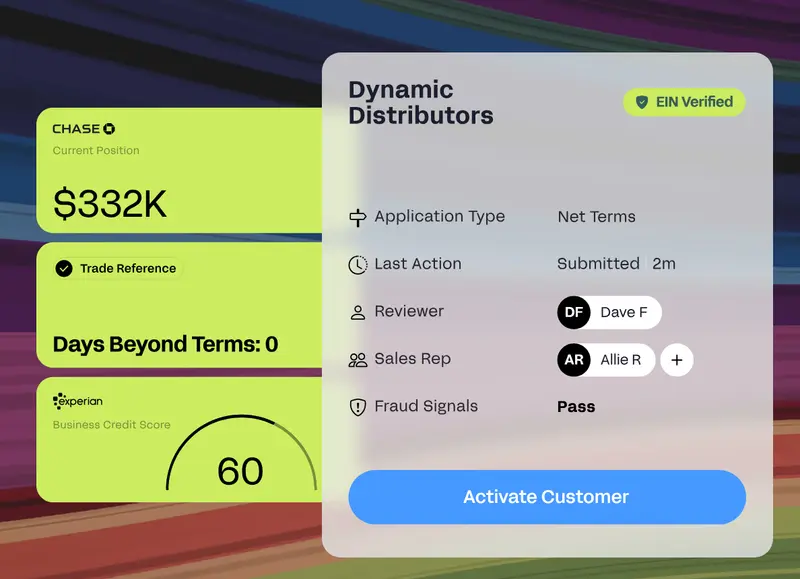
Automation isn't one feature bolted onto a credit application. It does distinct work at each stage of the workflow, and the value compounds when each stage feeds clean, verified data into the next one.
The most basic layer of automation happens before anyone reviews anything: required fields that can't be skipped, tax IDs and addresses validated automatically, applications routed to the right queue by region or business type, a simple form of segmentation that keeps reviewers focused on the applications they know best. None of that decides anything. It just keeps an incomplete application from becoming someone's problem three days later.
This layer confirms the applicant is a real, registered business before anyone spends time evaluating their creditworthiness. Legal name and tax ID matched against IRS and Secretary of State records, principal identity checks, and domain and address consistency checks all run automatically at the moment of submission rather than during a manual review days later.
A business that can't clear this layer shouldn't advance to a credit decision at all, automated or otherwise, no matter how strong the rest of the application looks.
This is one of the slowest and most measurable manual steps in the entire workflow. According to Nuvo's 2025 B2B Credit Insights survey, trade reference response time and bank reference response time were among the most frequently cited causes of approval delays. 27% of respondents also said a typical approval takes a week or more.
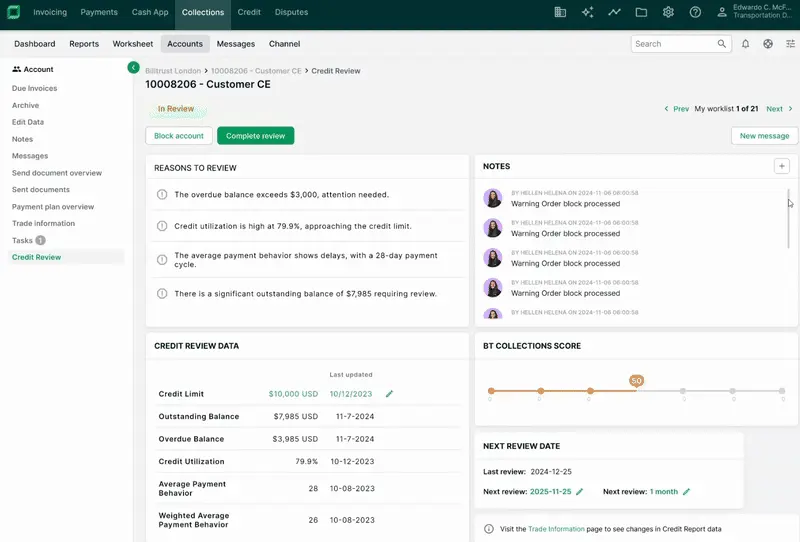
Not all of this is the same kind of automation, and conflating the two leads to either underusing simple tools or overtrusting sophisticated ones. Rules-based workflow automation is workflow logic:
AI-driven automation is different in kind, not just degree. Instead of following a fixed rule, an AI agent reads the applicant's data alongside external signals: bureau reports, bank data, trade reference responses, and research beyond what's in the application itself. It then makes a judgment call within the boundaries of a company's credit policy.
Nuvo's onboarding agent can also do things a rules engine can't initiate on its own, like automatically contacting an applicant to request a missing document rather than just flagging that one is absent, a form of automated communication a static rules engine can't perform.
Active use of AI across finance functions broadly more than doubled between 2024 and 2026 (30% to 75%), according to KPMG's Global AI in Finance survey of finance leaders across sectors. Credit onboarding is following the same trajectory, shifting from pure rules to AI agents that weigh context a rules engine can't.
See how agentic AI is expanding across trade operations for the deeper coverage of what these agents actually do and where they're headed.
Automation should take over the parts of onboarding that are the same every time, not the parts that genuinely require a person’s judgment, and pretending otherwise is how a team ends up trusting a system past its actual competence. It’s these human touchpoints that keep the process trustworthy.
Automation should route these judgment calls to a person instead of deciding alone:
Automated reference requests, sent electronically with structured response forms instead of a phone call and a follow-up email, cut the single biggest bottleneck in that timeline down to whatever the reference actually takes to respond, not whatever it takes a credit analyst to find time to call, turning data collection into the reference’s task instead of the analyst’s.
Once verification and reference data are in, decisioning automation applies a company's credit policy consistently.
It approves straightforward, low-risk applications automatically, requests the specific missing document or answer directly from the applicant instead of waiting on a person to notice, and routes anything outside policy to a human reviewer with the relevant data already attached on a shared dashboard, not a blank file and a name.
This is the stage where automation starts to look less like a checklist and more like a decision. That's why teams are most cautious about handing it over entirely, and why the routing logic matters as much as the approval logic.
The last stage pushes an approved customer's verified record, terms, credit limit, and account details directly into the ERP or customer relationship management system to complete account setup, instead of a person copying fields from a credit platform into a separate system by hand.
This is also where a lot of automated workflows stop without anyone noticing. Verification and decisioning get automated, but activation stays manual. As a result, the approved customer still waits on the same data-entry bottleneck the rest of the process was built to avoid, which drags down the customer experience the process was designed to protect.
A digital credit application that ends at a PDF approval and a separate re-entry step has automated most of the workflow and left the slowest step untouched.
The first is a risk judgment. The second needs a person who can weigh context a policy threshold wasn’t written to capture. The third is a business decision, not a verification outcome, and it should stay with the person who owns that relationship, often worked out on a kickoff call rather than decided by policy alone, since decisions here shape customer satisfaction and retention for your most strategic accounts.
The best customer onboarding platforms are built to make that routing decision itself automatic, so a person never has to remember which cases need their attention. The system surfaces them.
The mistake most teams make when they try to automate client onboarding is automating one stage in isolation, usually application intake, and calling the project done. That helps, but it doesn’t compound, because the clean data captured at intake still has to survive a manual handoff into verification, then another into decisioning, then another into the ERP.
Automation compounds when each stage of the customer journey feeds clean, verified data directly into the next one, application intake through ERP activation, without a manual step in between undoing the work the previous stage already did. That's what actually shortens time-to-value for a new account.
That’s the difference between automating a task and automating a workflow. It’s also what determines scalability as transaction volume grows. Automated customer onboarding is supposed to prevent exactly this: verified data getting re-entered, re-checked, or re-typed before it reaches the next stage.
The seam most onboarding automation leaves in place is this: clean data at intake, undone by a manual handoff two stages later. Look at your last ten new accounts. Where did clean data survive from intake through activation, and where did someone have to re-verify or re-key it? If the answer is the same step every time, that's where to start: see how Nuvo Intelligence runs application intake, verification, and decisioning as one workflow instead of five tools stitched together.