 Nuvo Platform
 Nuvo Intelligence
 Customer Onboarding
 Vendor Onboarding
 Portfolio Management
 Payments & Cash Application
 Collections
 Alcohol & Beverage
 Apparel
 Building Materials
 Chemicals
 Distribution
 Food Service
 Heavy Equipment
 Manufacturing




Loading
By Sid Malladi, Co-Founder & CEO
Book a demo
Every aging report has a long tail. The biggest accounts get a call from someone who knows them by name. Everyone else gets a templated email when a collector has a spare afternoon, or nothing at all. Collectors work business hours, and there are only so many accounts one person can work in a day.
That gap is why collections has become one of the most crowded corners of AI in finance. Most of the new tools solve the easy half of the problem. Today we're launching Collections on Nuvo, built to solve it all.
Few finance workflows are as ready for agents as collections, for three reasons.
So it's no surprise that a wave of point solutions now promises agentic collections. Most follow the same recipe: connect to the ERP, read the aging table, and let an agent send reminders on a schedule, with better copy and more channels than the dunning tools that came before. That has real value. A reminder that goes out on day one beats one that never goes out. But sending reminders at scale is the easy part, and it's quickly becoming table stakes. The harder question is what the agent should do when a customer doesn't pay, and answering it depends on knowing who that customer is.
On one side of every collections conversation is a customer who hasn't paid. And often, there’s a good reason for it: a disputed shipment, a tight quarter, an AP contact who left six months ago.
On the other side is a supplier who wants to get paid and keep the customer. Nobody wants to send a long-standing customer to a collections agency and sour a relationship that took years to build.
On the buyer's side, the automated dunning across email, text, and even phone calls pile up and eventually get ignored. And on the seller’s side, limited headcount forces picking which accounts get attention.
Handing this situation over to an agent that only sees a balance and a days-past-due count, and you can expect the same outcomes, only faster. Most agentic collections tools lack critical context as they are only plugged into the aging table in your ERP. When the stakes are a customer relationship, that's not enough to make the right call.
Today we're launching Collections and the Collections Agent. It works every account in your portfolio according to your policy, handles the routine work from first reminder to payment plan, and routes the accounts that need judgment to your team. Bigger book, same bench.
Collections runs on the same foundation as the rest of Nuvo: the Nuvo Network of more than 200,000 verified businesses, and the Trade Graph that maps how they trade and pay. So the Collections Agent doesn't start from just a balance and a due date. It starts from what the network knows about the business on the other end.
The agent's job breaks into three verbs: remind, resolve, reconcile.
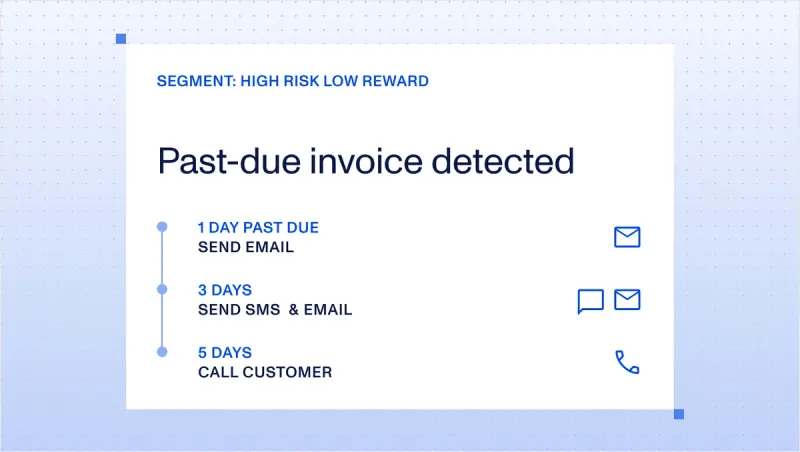
Verified contacts, not stale ones. Reminders go out by email, text, and phone to AP contacts verified when the customer onboarded on Nuvo, not whatever address was last typed into the ERP.
Segments built on the signals that predict payment. Your ERP tells you how much a customer owes. Nuvo tells you how likely they are to pay it. Group customers by balance, credit line, current bureau score, linked bank activity and NSF history, years as a customer, the tier you've assigned, or any other field in your ERP. Then, give each segment its own cadence, channels, and tone.
Take two accounts. Customer A is five days late on $50,000, with a stable credit score, healthy cash reserves, no disputes, and years of on-time payments. Customer B is two days late on $25,000, with a declining score, a recent NSF, and no reply to earlier outreach. A typical aging report would suggest Customer A is the top priority. But the Collections Agent, armed with this additional context, sends Customer A a friendly reminder while escalating Customer B to your team.
Outreach that adapts to every response, or the lack of one. The agent knows where each invoice sits in the aging table. It also knows the customer's payment history, sales volume, bureau score, tier, and how they've responded to each channel before. If a customer stops opening emails, the agent switches to text or a call instead of sending another email. It works alongside the other Nuvo Intelligence agents across onboarding, monitoring, and AR, drawing on the same shared context.
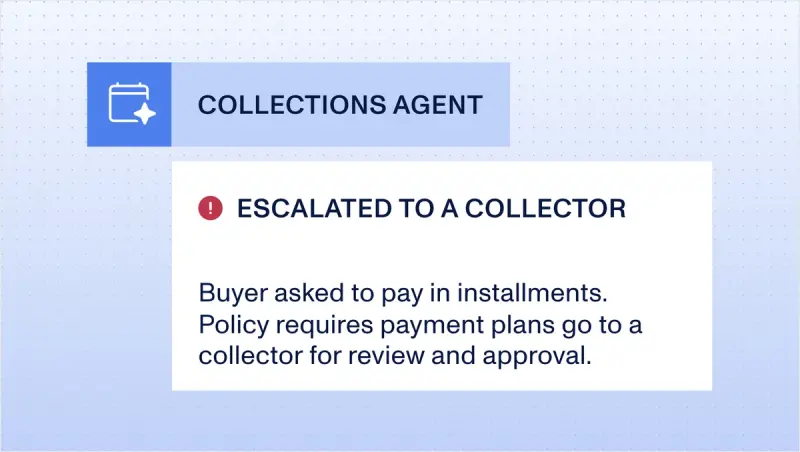
The first question finance leaders ask us is whether agents can be trusted with their customer relationships. That depends on two things: what the agent knows, and what it's allowed to do. The Collections Agent knows each customer's full history, not just with you but across all of its supplier relationships on the Nuvo Network. And it acts only within the policy you set, handing the account to your team the moment a conversation calls for judgment. You decide where its authority ends.
It handles the conversation. Customers reply, and the agent responds across email, text, and phone calls. When a customer commits to a pay date, the agent logs it and pauses outreach, and your team sees the same commitment.
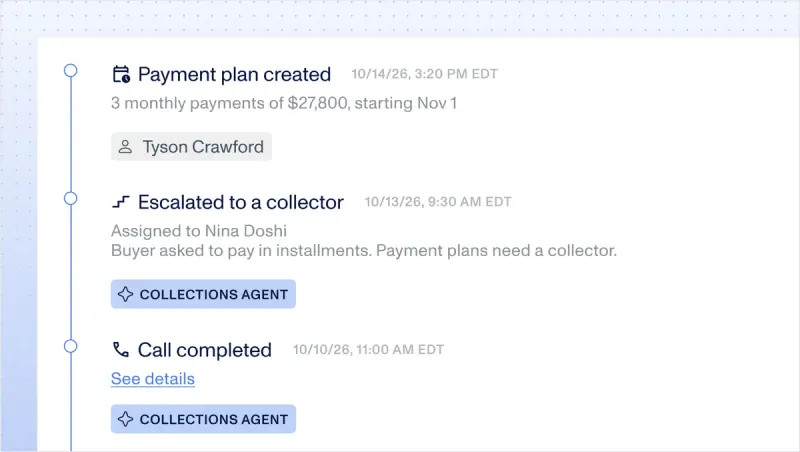
It builds payment plans within your limits. The agent can set up and manage a payment plan and record the agreement on the account. Anything beyond your pre-determined limits gets escalated to a person.
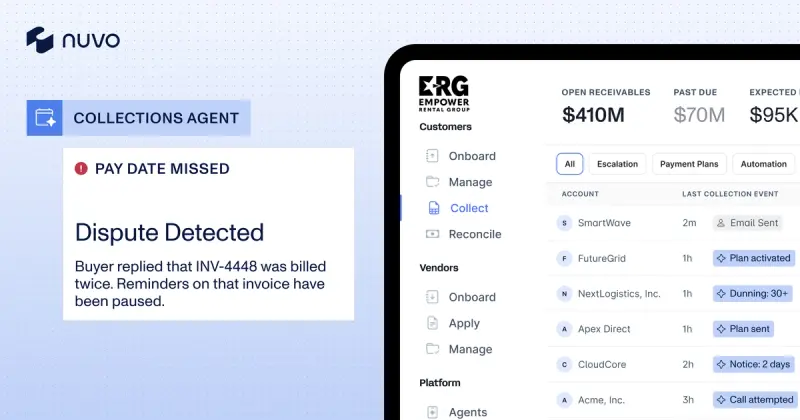
It knows when to stop. Disputes halt the agent in its tracks and they hand the account over to your team, with the full conversation attached. Keep any segment out of automation entirely, whether that's your top accounts or customers in an active negotiation.
Every touch is on the record. Every email, text, call, note, and promise to pay sits on a unified timeline, with each interaction clearly labeled so you know whether the agent or a person did the work. And all of it syncs to your ERP in real time. One review queue points collectors to the accounts that need them. Your ERP stays the system of record, and every action can be traced and explained.
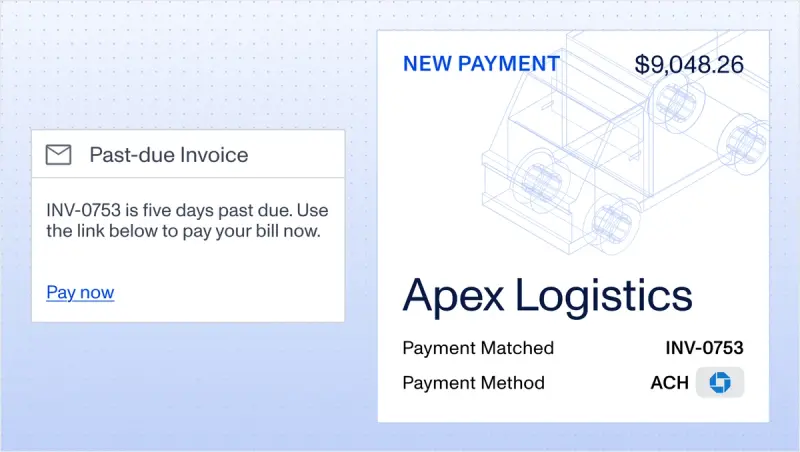
Collections carries the conversation up to the moment a customer agrees to pay. Pay & Reconcile takes it from there: accepting the payment and applying it to the right invoices. Run them together as our AR Suite, and a past-due invoice moves from first reminder to reconciled cash in your ERP in record time, all with no manual handoff.
Every past-due reminder carries a link to your branded payment portal, where customers can see open invoices and make a payment using any of their stored payment methods. As soon as the payment is initiated, the Cash Application Agent works to match it to the right invoices and then updates your ERP. No one has to chase the payment, key it in, or match it by hand.
While most Collections tools stop at reminders, Nuvo reminds, resolves, and reconciles.
Every collections tool, including Nuvo’s, is trying to change one behavior: getting customers to pay on time. Most do it by pushing harder, with more reminders across more channels, with earlier escalation. With Nuvo, your customers get a new reason to want to pay you on time.
It’s only possible because of the Nuvo Network. Each of the more than 200,000 businesses on the Network has a verified identity, tied to real trade relationships and real payment history. So when a customer pays you on time, that payment can be reported as a verifiable trade line, attributed to the right business with confidence. A collections tool that only reads your ERP knows a customer name and an invoice. That isn't enough to report a trade line a bureau can stand behind.
For the launch of Collections, we've partnered with Creditsafe as our first bureau partner for sharing on-time payment information. When your customers pay you on time, it builds their business credit. And it all is your call: if offering your customers the ability to build credit with on-time payments isn’t right for you, you can opt out.
My favorite example of this is actually on the consumer side, where Bilt blazed a trail by turning rent, the biggest bill most people pay, into a payment that builds credit. Renters got a reason to pay on time and a reason to stay. Five years later, Bilt has changed how hundreds of thousands of renters think about their rent payments.
The same logic holds when it comes to B2B trade. For the businesses buying from you, business credit shapes the terms they get from every other supplier and lender they work with. When cash is tight and they have to choose which bills to pay first, the supplier whose invoices build their credit moves up the list. And when they're choosing between two suppliers with similar products and terms, it's a reason to pick you, and keep picking you.
No other collections product can offer this, because none of them sit on a network of verified businesses.
Early Collections customers are already seeing lower DSO.
But the even bigger effect shows up across the full customer lifecycle. Companies that run order-to-cash on Nuvo, from onboarding through collections, see new customers become repeat customers at more than 2.5x the rate they did before. On average across the Nuvo customer base, that’s an improvement from 20% to 52%, a 32-point lift.
Repeat customers are some of the most profitable revenue a supplier can earn. Instead of going out to find and win new business and run them through onboarding and credit decisioning, the relationship is already in place, so every additional order comes at a fraction of what it costs to secure a new customer.
Collections rounds out the tail-end of the order-to-cash process on Nuvo. Customer Onboarding verifies who a business is and how much credit it can carry. Portfolio Management watches that customer for as long as you trade with them. Pay & Reconcile and Collections turn invoices into cash. Each step runs on the same network and shares the same context, so what Nuvo knows about a customer the day they applied and then every day in between informs how you collect from them years later.
That connected cycle is one supplier's view of something larger. Today, every trade relationship runs on two sets of books: the supplier's and the buyer's, kept in separate systems that rarely agree. The supplier shows five open invoices; the buyer says two were paid. People spend days reconciling two versions of the same transaction, and AI added on top still only sees one side.
We're building the agentic commerce network for physical trade, where buyers and suppliers work from one shared source of truth, agents take on the transactional work on both sides, and teams keep the judgment calls. Every business that joins makes the network more useful to every business already on it.
Collections is where that starts to show up on both sides of the ledger. Suppliers collect more of what they're owed without straining the relationship, and buyers build credit every time they pay on time. Creditsafe is our first bureau partner, and we plan to add more.
To see what agentic Collections, backed by the Nuvo Network, can do for your business, from lowering DSO to growing a base of repeat customers who pay on time, book a demo.