 Nuvo Platform
 Nuvo Intelligence
 Customer Onboarding
 Vendor Onboarding
 Portfolio Management
 Payments & Cash Application
 Collections
 Alcohol & Beverage
 Apparel
 Building Materials
 Chemicals
 Distribution
 Food Service
 Heavy Equipment
 Manufacturing




Loading
Book a demo

Swapping a manual invoicing step for a new tool is a purchase. Transforming order to cash means changing how credit, invoicing, and collections work together, with a timeline and a budget attached to it. Confusing the two is how a company buys software, sees one metric improve, and wonders why nothing else changed.
The distinction matters because the two paths look similar at the start. Both begin with a vendor demo and a signed contract. They diverge in what happens next: a purchase ends when the tool goes live, while a transformation is only getting started once the new system is running, because the sequencing, ownership, and measurement decisions still have to happen.
Scope this to the functions your credit and finance team actually own: customer onboarding, credit decisioning, invoicing, cash application, collections, and reporting. It doesn’t extend to the full supply chain, warehousing, or fulfillment, even though those functions sit upstream and downstream of the cash cycle.
Keeping the scope tight matters for two reasons. First, credit and finance teams control the systems and data inside that boundary, so a project stays achievable when it stays inside it. Second, a transformation that tries to touch procurement, inventory, and shipping in the same initiative adds coordination overhead that has nothing to do with getting paid faster.
That doesn't mean the boundary is rigid. Order fulfillment status affects when an invoice can go out, and shipping delays push back the invoice date, and with it the start of payment terms. The functions credit and finance own still need visibility into what's happening upstream, even without owning those upstream processes directly. A connected covers the full cash cycle, from credit decision through collected payment, without needing to absorb the rest of the business to do it.
Three shifts separate a connected cycle from a set of automated tasks bolted onto the same process:
When credit, invoicing, and collections read from the same record, a limit change or a short payment is visible to the next function the moment it happens, not weeks later in a separate report. That's the mechanism behind all three shifts. A faster tool sitting on top of disconnected systems doesn't produce it.
Treat this as a sequence of phases, not a single cutover. Which piece changes first typically matters more than how fast the whole project moves.
Map where credit, invoicing, and collections data actually lives before choosing anything. Identify which step causes the longest delays, where manual re-entry happens between systems, and which ERP or system nobody fully trusts. Time how long invoice generation actually takes today, from the trigger event to the invoice landing with the customer.
Then pull the last quarter’s numbers for each stage: average days to approve credit, average days from approval to invoice delivery, and average days from invoice to payment. This assessment determines the sequence in the next phase, so skipping it means guessing at priorities instead of setting them from evidence.
Rank the changes by friction, not by ease of implementation. The highest-friction step, the one costing the most time or money today, goes first, even if it's the harder piece to build. A company that starts with the easy win instead often finds the hard problem never gets addressed, because the appetite for further change fades once the visible quick win is banked. Attach a specific metric to each phase, whether that's DSO, days to first invoice, or percentage of payments auto-matched, so success is measurable rather than assumed.
Launch the first phase, measure it against the metric you defined, and adjust before starting the second. A phased rollout catches a bad assumption after affecting one process instead of five, and it gives the team evidence to bring back to the executive sponsor before asking for the next round of budget. AI agents built for accounts receivable are often introduced this way, starting with one workflow like cash application before expanding into collections and credit once the first phase has proven out.
Most stalled projects fail for the same handful of reasons:
This failure pattern extends well beyond order to cash. According to Gartner's 2025 CIO and Technology Executive Survey, which polled more than 3,100 CIOs and technology executives alongside 1,100 executive leaders outside IT, only 48% of digital initiatives enterprise-wide meet or exceed their business outcome targets. The group Gartner calls the "Digital Vanguard" hits 71%, and the difference is ownership: their CIOs co-own delivery with business leadership instead of treating it as an IT-only project.
The technology enables the shift. The change itself is organizational: which step gets sequenced first, who owns each decision, and what gets measured along the way. A company can install the most capable platform on the market and still end up running the same process if nobody assigned ownership or defined what success looks like.
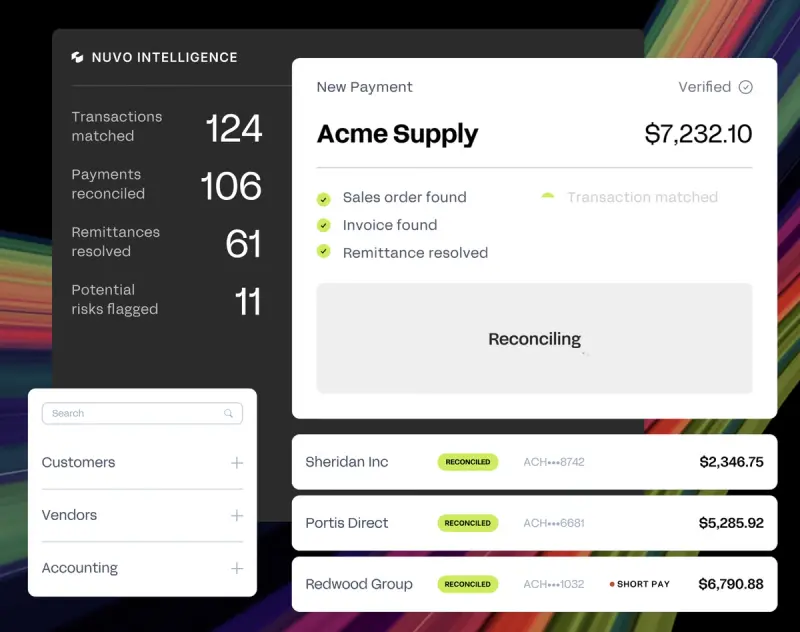
Accounts receivable technology built on shared data across onboarding, credit, invoicing, and collections is what makes the sequencing in this guide possible in the first place, since each phase can build on data the last phase already verified instead of starting over. Nuvo Intelligence runs four agents on that shared data, each tied to a stage of the cycle: the Onboarding Agent turns applications into review-ready files, the Monitoring Agent watches existing accounts for shifts in payment behavior, the Cash Application Agent matches payments to open invoices, and the Collections Agent handles follow-up. A credit decision, a payment, and a collections outreach all draw from the same current picture of the account instead of three separate snapshots taken at different times. One early Nuvo customer dropped credit decisioning timelines from 14 days to a few hours, and more than 50% of their new applications are now handled automatically without human review.
Start with the step that's costing you the most today, not the one that's easiest to pitch. Pull last quarter's numbers for three stages: days to approve credit, days from approval to first invoice, and days from invoice to payment. The largest of those three is your first phase, whether or not it's the one with a vendor demo already scheduled.
If the delay comes from handoffs between systems rather than any single step, see how Nuvo connects onboarding, credit, and collections on shared data.
A single phase, such as automating cash application or moving credit decisioning onto shared data, typically takes a few weeks to a few months depending on how many systems need to connect. A full transformation across credit, invoicing, and collections usually runs six months to over a year when done in phases, since each phase needs time to prove out before the next one starts. Trying to compress that timeline by launching every phase simultaneously is a common way projects lose the evidence they need to justify continued investment.
Automating a task speeds up a single step, like sending invoices automatically instead of manually. Transforming the process changes how credit, invoicing, and collections work together, so a decision made in one function reaches the next without a handoff. A company can automate a dozen individual tasks and still run the same disconnected process if those tasks don't share data with each other.
The project needs a single executive sponsor, typically a CFO or VP of Finance, who is accountable for the outcome across credit, invoicing, and collections. That person doesn't need to run the day-to-day work, but they need the authority to resolve conflicts between departments and the standing to keep the project funded when a competing priority shows up. Without that ownership, each function optimizes its own piece independently, and the coordination the project actually requires never happens.