 Nuvo Platform
 Nuvo Intelligence
 Customer Onboarding
 Vendor Onboarding
 Portfolio Management
 Payments & Cash Application
 Collections
 Alcohol & Beverage
 Apparel
 Building Materials
 Chemicals
 Distribution
 Food Service
 Heavy Equipment
 Manufacturing




Loading
Book a demo

When application volume outpaces your in-house team, two different fixes get floated in the same meeting: outsource it, or automate it. They get treated as interchangeable answers to the same question. They aren't.
Outsourcing adds people to a manual process. Automation removes the manual work. One buys you capacity. The other changes what your team actually has to do. Order to cash outsourcing can be the right call, but only once you know which problem you're actually solving.
Order to cash, or O2C (sometimes abbreviated OTC), covers everything between a customer placing an order and your company collecting payment for it, including order entry, credit approval, order fulfillment, invoicing, collections, payment processing, and cash application. It's the revenue cycle for any B2B company, and it sits opposite procure-to-pay and accounts payable, which track what you owe suppliers rather than what customers owe you. Some people use order to cash and quote-to-cash interchangeably, though quote-to-cash technically starts one step earlier, at the quote or contract stage.
Outsourcing spans a wide range of setups:
The case for outsourcing is straightforward, and it's the entire case most BPO providers make. It holds up in four specific situations.
Hiring, training, and retaining a full credit and collections team is expensive, especially for a mid-market company that doesn't need that headcount year-round. Outsourcing swaps fixed payroll for a variable cost tied to volume, which is attractive when your order to cash workload doesn't justify a full-time team but still needs coverage.
A dedicated provider running invoicing and payment collection all day, every day, usually processes faster than a generalist internal team juggling O2C alongside other finance work. That speed shows up directly in days sales outstanding (DSO), the metric most sensitive to late payments and, by extension, to working capital and liquidity. Uneven cash flow was cited as a financial challenge by 51% of employer firms in the Federal Reserve's 2025 Report on Employer Firms, and faster collections are one of the more direct levers against that.
Providers that only do order to cash see more edge cases across more industries than an internal team typically will. That translates to sharper credit management practices, more consistent credit checks, and collections staff who know which approach gets a slow-paying customer to respond.
A company scaling fast, or one with sharp seasonal spikes, can flex outsourced capacity up or down without the lag of hiring and training. That elasticity is hard to replicate with a fixed internal team.
Search for "order to cash outsourcing" and nearly every top result comes from a provider selling the service. Their content lists benefits and stops there. The drawbacks are just as real, and they matter more the longer the relationship runs:
Outsourcing adds hands to a process that's still manual. Someone is still keying in orders, still manually matching payments to invoices, still calling customers off a spreadsheet. It just isn't your headcount doing it anymore. Automation is a different kind of fix. It removes the manual work itself. Order entry, invoice generation, payment matching, and collections follow-up happen inside a system instead of inside a person's inbox.
The two aren't mutually exclusive. Some companies run automated order to cash software and outsource the exceptions it can't handle. But they answer different questions. Outsourcing asks, "Who does this work?" Automation asks, "Does this work need a person at all?"
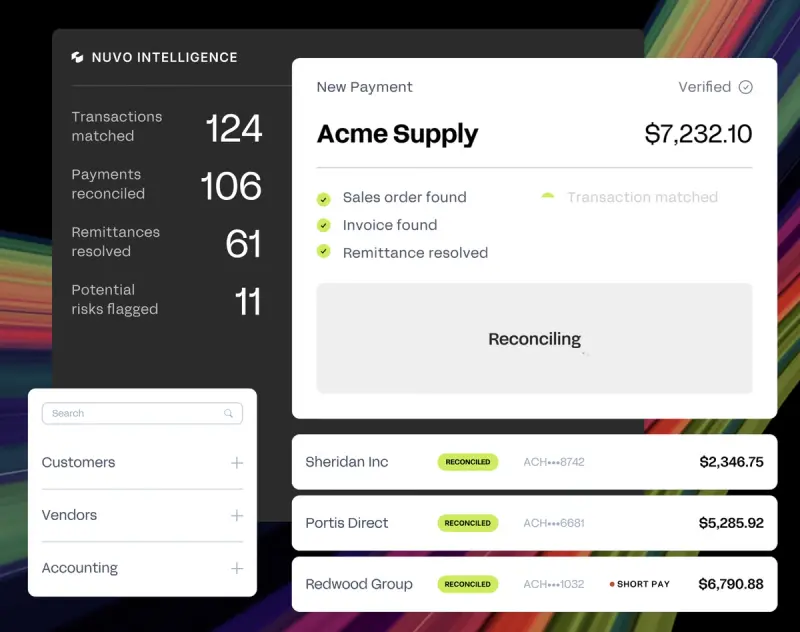
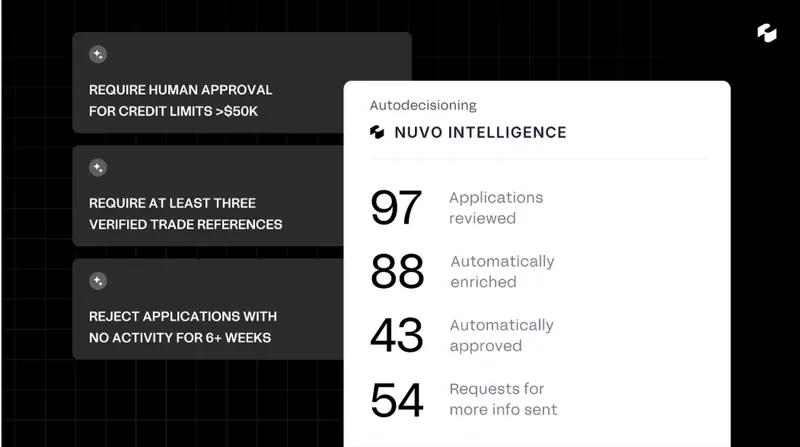
Nuvo’s platform is built around that second question, and it starts where this article started: application volume. The Onboarding Agent runs verification while a customer is still filling out the credit application, so what reaches your team is a decision-ready profile rather than a half-complete form someone has to run down. The judgment call stays with your credit team. The gathering, checking, and following up doesn’t.
Further down the cycle, Nuvo’s accounts receivable platform applies the same idea. Agents handle cash application, matching payments to open invoices as they arrive, and run collections follow-up on a cadence your team sets, escalating only the accounts that need a human. Your ERP stays the system of record, with invoices, balances, and payment status syncing back automatically, so accounts receivable management runs through one connected system instead of a spreadsheet and a vendor portal.
Your team keeps the customer relationships. And because the routine work runs in software instead of through someone else’s staff, the efficiency doesn’t cost you the relationship to get it.
Go back to the three buckets. If what you’re looking to outsource is mostly verification chasing, payment matching, and routine follow-up, that’s a sign the work should be automated, not staffed by someone else’s team. Add capacity without handing your customer relationships to a vendor. .
Before signing an order to cash outsourcing contract, sort the work into three buckets:
Once you've sorted the work, ask a few direct questions before you sign anything:
No. Outsourcing hands O2C tasks, like invoice processing or collections calls, to a third-party provider's staff. The work is still done manually; it's just done by someone outside your company. Automation replaces the manual steps with software that handles order entry, invoicing, cash application, and collections directly. Some companies use both: automated software for routine volume, with outsourced staff handling exceptions or overflow.
Collections calls and invoice processing are the two functions companies outsource most often, since both are high-volume and relatively standardized. Cash application and basic order entry come next. Credit approval, especially for large or high-risk accounts, and dispute resolution are outsourced far less frequently, since both depend on judgment calls and context a third party usually doesn't have.
Track the same KPIs before and after: DSO, cost per invoice or per collections call, dispute resolution time, and bad debt as a percentage of revenue. Weigh the labor cost savings against what you lose in control and context, including any increase in customer complaints or billing errors. A provider that lowers cost per transaction but drives up DSO or write-offs isn't delivering a real return, even if the invoice from the vendor looks smaller.