 Nuvo Platform
 Nuvo Intelligence
 Customer Onboarding
 Vendor Onboarding
 Portfolio Management
 Payments & Cash Application
 Collections
 Alcohol & Beverage
 Apparel
 Building Materials
 Chemicals
 Distribution
 Food Service
 Heavy Equipment
 Manufacturing




Loading

Vendor due diligence is the process of verifying a vendor's identity, financial health, and compliance standing before your business starts paying them, and continuing to verify it for as long as the relationship runs.
It sits inside the broader discipline of third-party risk management, but for a company that buys physical goods, that scope looks narrower than most due diligence content suggests.
Vendor due diligence means financial stability, fraud exposure, and compliance documentation: the things that determine if a vendor should get paid at all, not the deep cybersecurity and data-access review that dominates third-party risk content built for SaaS vendors touching sensitive systems.
Vendor due diligence happens at three points: before a contract is signed, the moment a vendor is added to your payment system, and on an ongoing basis through continuous monitoring. Most of the risk conversation focuses on the first two. The third is where most third-party risk management programs stop, which is exactly why it's the gap worth paying attention to.
Skipping or rushing due diligence has specific costs. Fraud is the most direct. Asset misappropriation schemes, including fake vendors and inflated invoices, showed up in 90% of the cases in ACFE's 2026 occupational fraud report, with a median loss of $100,000 per case and a median of 12 months before anyone caught it.
Compliance exposure follows close behind. A vendor's tax documentation you never verified can trigger mandatory backup withholding on every payment once a mismatch surfaces, turning a paperwork gap into a cash flow problem. A vendor that turns out to be financially unstable is a business continuity risk to your supply chain, regardless of how the relationship started.
According to the Bureau of Labor Statistics, one in five new business establishments don't survive their first year. The vendor that looked solid at signing isn't guaranteed to be around next quarter.
None of these three costs show up on the same timeline. Fraud losses compound the longer they run undetected, a compliance gap surfaces months after the payment that triggered it, and a vendor's financial decline is rarely visible until they've already missed a delivery.
Each of these answers a specific question about the vendor. None of them exist to be checked off for their own sake. Skipping one leaves a specific question unanswered about a business you're about to pay.
Is this a real, registered business, and is the entity you're paying the same one you contracted with? Matching the legal name, business registration, and tax ID against government records answers that directly.
A mismatch here is often the first sign of a fictitious or impersonated vendor, and it's the check that keeps that vendor from ever entering the payment system in the first place.
Can this vendor actually deliver on what they're committing to, and are they at risk of failing mid-relationship? A business credit application and a review of financial statements answer the equivalent question on the customer side of a trade relationship, and the same logic applies here in reverse.
A vendor's financial fragility introduces financial risks that become your operational risk, not just theirs. A single bad quarter doesn't necessarily disqualify a vendor, but a pattern of declining payment behavior with their suppliers, mounting liens, or an unexplained shift in beneficial ownership is worth a closer look before the next purchase order goes out.
Does this vendor's paperwork hold up during a regulator or auditor review? A valid W-9 or W-8, current insurance certificates, and any required licensing all answer that question. You need to validate these at intake rather than assume they’re complete just because the form was filled out.
A W-9 with a name and TIN that don't match is the kind of gap that turns up during a 1099 reconciliation, long after the payments it applies to have already gone out.
Does the bank account on file actually belong to this vendor, and would you know if that changed? Instant or micro-deposit verification against the bank itself answers this. A voided check does not, no matter how official it looks.
A "routine" update to an existing vendor's account deserves the same verification as a brand-new one, since that's the moment a fraudster is most likely to strike.
Has this vendor actually delivered what they claim to, with businesses that have already worked with them? Trade references and payment history from other buyers answer a question the vendor's own application never fully can, since nobody presents their own weakest evidence.
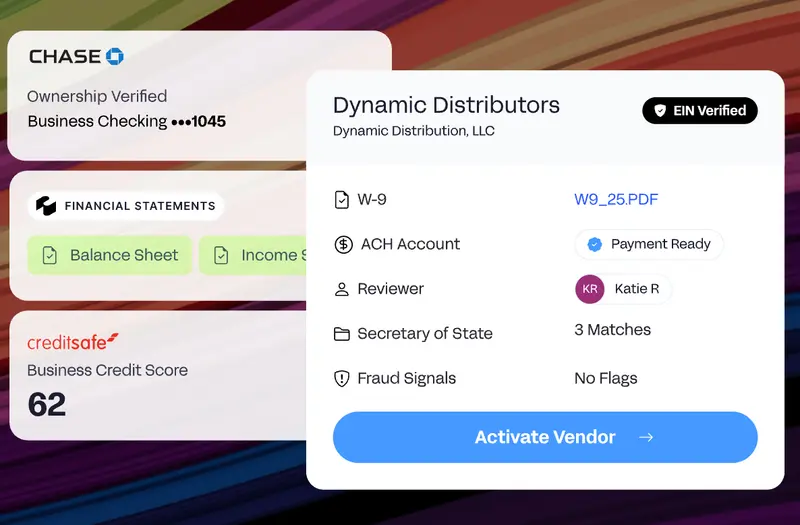
Most teams make the mistake of running the same checklist on every vendor regardless of size. This calls for a risk-based approach: a one-time vendor supplying a small, non-critical order doesn't warrant the same depth of review as a supplier receiving six figures a year in payments and holding a critical position in your supply chain.
Set two or three tiers based on annual spend, risk profile, and how critical the vendor is to your operations, then define what level of diligence and risk scoring each tier requires:
An approval from five years ago tells you what a vendor looked like then. But ownership changes hands, financial health can deteriorate or improve, and a tax exemption certificate can expire without anyone noticing. None of that shows up in a file that was never reopened after onboarding or revisited at contract renewals.
Ongoing monitoring, refreshed compliance documents, a periodic look at financial health, and a flag when banking details change are what keep an approval from expiring while everyone still treats it as current.
Due diligence works best as a byproduct of onboarding and ongoing monitoring, not a separate audit exercise someone has to remember to schedule. A program that depends on a person setting a calendar reminder to re-check a vendor's financials is a program that will eventually miss the reminder.
The same credit management discipline that runs continuously on the customer side of a trade relationship should run just as continuously on the vendor side. Risk doesn't hold still just because a review already happened once.
This tradeoff between a periodic audit and a connected, always-on process shows up on the credit side too, where teams evaluating alternatives run into the same question of whether risk monitoring is built in or bolted on after the fact.
How many of your active vendors have you re-verified since the day you onboarded them? If the answer is close to zero, that gap is bigger than it looks, and it's the same gap that B2B trade credit automation closes on the customer side of the ledger.
The Nuvo Network builds those checks directly into onboarding and keeps them running afterward, drawing on a verified base of 185,000+ businesses so nothing has to be verified twice. See how it works.
Vendor due diligence is the verification work itself, confirming identity, financial health, and compliance standing before and during a relationship. Vendor risk management is the broader program that uses that verification to make decisions: setting risk tiers, defining escalation triggers, and deciding how a vendor's status should affect spend limits or approval requirements.
Due diligence produces the information; risk management is what an organization does with it.
It depends on the vendor's risk tier and spend level, but the honest answer for most B2B teams is more often than a one-time onboarding check. Reverify banking details every time they change, not on a schedule.
Financial health and compliance documentation are worth a periodic look, at minimum annually for higher-spend vendors, and immediately if a red flag surfaces, a missed delivery, a payment dispute, or a change in ownership, rather than waiting for the next scheduled review.