 Nuvo Platform
 Nuvo Intelligence
 Customer Onboarding
 Vendor Onboarding
 Portfolio Management
 Payments & Cash Application
 Collections
 Alcohol & Beverage
 Apparel
 Building Materials
 Chemicals
 Distribution
 Food Service
 Heavy Equipment
 Manufacturing




Loading
Book a demo

Every finance team reaches the same decision once vendor volume climbs past a certain point: keep running the vendor onboarding process the way it's always run, patching each new exception as procurement, finance, or accounts payable happens to catch it, or build a process that holds up when an auditor asks for it and doesn't need a new hire every time vendor count doubles.
The second option takes more upfront work. It’s also the only one that scales.
Some teams call this supplier onboarding, others vendor onboarding, and job titles like supplier management or vendor management often describe the same function under a different name. The practices below apply either way.
Vendor onboarding touches procurement, finance, and accounts payable (AP), and none of the three owns the whole thing by default. Procurement teams run the request for proposal (RFP) and select the vendor. Finance sets payment terms. AP collects the tax forms and creates the vendor record. When ownership is split like that, gaps become normal instead of rare, and unassigned ownership is where compliance risks and fraud exposure both start.
Left unassigned, these are the gaps that surface:
Each gap looks small in isolation. Together, they're what shows up in an audit finding or a fraud loss. Third parties were the entry point for 35.5% of security incidents in 2024, up 6.5 points from the year before, according to SecurityScorecard's 2025 Third-Party Breach Report. A vendor onboarding process is where that exposure gets caught early or waved through.
The same risk practices credit teams use to vet customers, often through dedicated credit management software, apply just as well in the other direction, when you're the one paying instead of getting paid.
Spreadsheets and email threads don't hold up once more than one department touches a vendor record. Procurement keeps its own tracker for RFP responses. Finance has a separate list of payment terms. AP has whatever's in the ERP, which may or may not match either of the other two. By the time a vendor asks why a purchase order doesn't match the rate they were quoted, three people are checking three different sources to find the answer.
A single source of truth doesn't mean one more spreadsheet everyone forgets to update. It means one vendor record that procurement, finance, and AP all read from and write to, whether that’s a dedicated vendor portal or a module inside the ERP or procurement system you already run. Vendors submit invoices, compliance documents, and updated banking details to the same place every time, and an API keeps that data flowing into the ERP without someone re-keying it. A vendor onboarding checklist that lives in someone's inbox is hard to audit and even harder to hand off when that person changes roles.
Centralizing the data also gives you an audit trail: a record of who submitted what, when it was verified, and who approved it, instead of a reconstruction project after the fact.
Running the same depth of vendor risk assessments on a $500 one-time vendor as on a seven-figure sole-source supplier wastes the time that should go to the vendor that actually carries risk. Set tiers by spend and risk, not by whichever vendor happens to be loudest about needing to get paid quickly.
Automated identity and bank verification makes this practical: it handles the routine confirmations in minutes so your team's due diligence time goes to the vendors that actually need it.
These vendors can move through with the basics:
Automated verification confirms all three in minutes instead of a manual callback, so this tier doesn't slow anyone down.
These vendors justify a deeper file:
That's what a risk-based model buys you as part of a broader third-party risk management program: less time spent on vendors that don't need it, and a real risk assessment for the ones that do.
A tiering model doesn't help if nobody owns moving a vendor from one step to the next. Name an owner and a service level agreement (SLA) for each stage: collection, verification, and approval. Procurement owns getting documents collected during the RFP process. Someone in finance or AP owns verification once the file is complete. A named approver, not a queue, owns the final sign-off.
Track cycle time against that SLA, not just at the end of the process. The median company takes three days to set up a new supplier in its procurement system, according to APQC's benchmarking data across more than 3,000 organizations, and that number climbs fast once a step sits on nobody's desk. Build an escalation path for files that stall past the SLA, so a stuck vendor becomes a KPI a manager sees, not a mystery procurement discovers when the vendor calls asking where their first purchase order went. Strong supplier relationships depend on the vendor knowing who to call when a payment is late or a document needs updating, not guessing which of three departments picks up.
Vendor risk management doesn't stop at approval. A vendor's risk profile at onboarding says nothing about what it looks like 18 months later:
Re-run identity and bank verification whenever a vendor changes its payment details, since that's also the single most common moment fraud shows up. Reassess risk tier on a schedule, not just when something goes wrong: annually for high-risk, high-spend vendors, and at renewal for everyone else.
The vendor network helps too: a vendor's status updates once, and every company relying on that record sees the change, instead of everyone re-verifying the same vendor from zero. Vendor code of conduct commitments, like data handling standards or labor practices attestations, deserve the same periodic check as financial and compliance documents, not a signature filed away and forgotten.
Centralizing data, tiering risk, assigning ownership, and monitoring after go-live reinforce each other. Skip one and the other three get harder to sustain. Teams that treat vendor onboarding as a living process, not a one-time checklist, activate new vendors faster and catch risk earlier, because the same verified data structure that speeds up intake is what makes ongoing monitoring possible. Manual processes don't compound that way. Every new vendor is a fresh spreadsheet row and a fresh set of emails, and the effort resets every time.
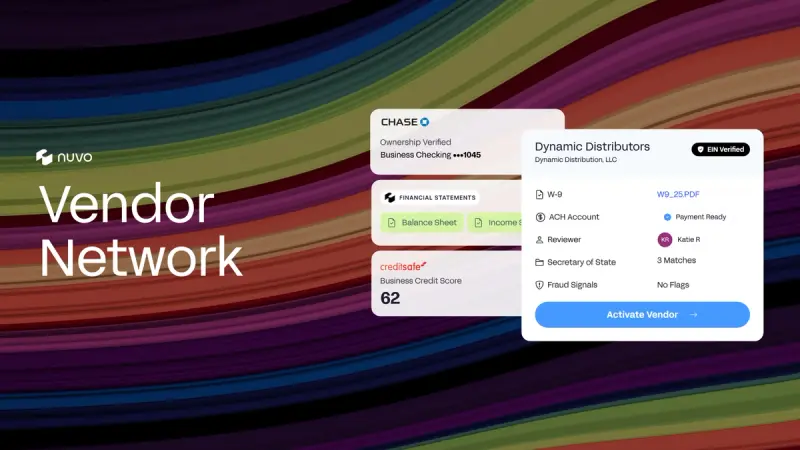
Nuvo's vendor onboarding platform replaces the document checklist with automated verification: business identity checks against IRS and Secretary of State records, KYB verification, and bank account confirmation before a payment ever goes out. Every vendor gets one verified record instead of one file per department, and role-based approval workflows keep procurement, finance, and AP working from the same data instead of three different trackers.
Nuvo built its customer onboarding platform for B2B credit teams around the same verification logic, so the discipline that speeds up onboarding on the customer side works the same way on the vendor side. That's what these vendor onboarding best practices add up to: a process that scales without adding headcount every time vendor count doubles.
Look at your last five vendor files. If any of them skipped a risk tier, sat without a named owner, or never got reassessed after go-live, that's the gap automated verification closes. Turn a document checklist into automatic verification against IRS, Secretary of State, and bank data. See how Nuvo does the checking for you.
Vendor onboarding is the one-time process of verifying a new vendor and setting them up to receive purchase orders and payment: collecting compliance documents, confirming bank details, and assigning a risk tier. Vendor management is what happens after that, on an ongoing basis: tracking service level agreements, maintaining the relationship, and reassessing risk as circumstances change. Onboarding is the front door. Vendor management is everything that happens once a vendor is inside.
Most delays trace back to unclear ownership: a document sitting in someone's inbox because no one was assigned to review it, or a vendor record stuck between procurement and finance with neither team sure who approves it next. Missing compliance documents cause the rest, especially when a vendor doesn't know what tier they fall into or what a high-risk file requires. Naming an owner and an SLA for each step removes most of the delay before it starts.
At minimum, annually for high-risk, high-spend vendors and at renewal for everyone else. Reassess sooner any time a vendor changes bank details, appears on an updated sanctions list, lets an insurance certificate lapse, or shows signs of financial instability. Risk tier isn't a one-time label. A low-risk vendor that wins a much larger contract with you should move up a tier the next time spend changes materially.